Why Anthropic & OpenAI’s Trillion-Dollar IPOs Are Bad News for the Rest of Us.
Anthropic just filed for its IPO, with a target valuation north of $1 trillion. OpenAI is lining up right behind it. Great for Anthropic and its early investors. But the question nobody’s asking: what does this mean when the future of whole economies depends on broad AI deployment?
While the AI companies burned through private investor money, no one had to care about profits. But as public companies, they’ll need to produce huge, durable profits to justify those valuations. Two trillion-dollar AI listings inside a few weeks. Someone has to pay for them.
And that someone is us.
But there’s a deeper shift hiding in these numbers. An IPO used to start cautious — a modest price that left room to prove yourself, and upside for the investors who believed early. The company had to earn its higher valuation over time.
Not anymore. These valuations are already maxed out on day one. Much of the future potential is priced in before the stock even trades. And yet the price is still supposed to rise. From an already maximized level, that doesn't leave room for patient growth — it breeds inflated expectations that force moves which are rational if the goal is to drive up the share price, but a big problem for everyone else.
The price sets the wrong incentives
Compare this to AI companies in China. While Anthropic is asking for north of $1 trillion, DeepSeek — China’s flagship lab, whose open-weight models rattled the entire US AI trade — is raising its first outside money at around $55 billion. MiniMax went public in Hong Kong at roughly $11 billion. Put DeepSeek, MiniMax and Zhipu together and you land near $70 billion — less than a fifteenth of Anthropic’s ask alone.
This isn’t about the Chinese firms being cheaper — most of them lose money too; MiniMax booked a roughly $250 million net loss last year on under $80 million of revenue. It’s about the sheer scale of return each system has promised its investors. Justifying $1 trillion requires extracting a level of future profit that justifying $55 billion simply doesn’t. And it matters that DeepSeek stayed deliberately self-funded for years precisely to avoid that investor pressure.
The bigger the valuation, the harder the eventual squeeze.
But Western AI labs have a fix for this, one we already know by heart, because the hyperscalers have run it for a decade: lure customers in cheap, make them dependent, make switching painful, then slowly turn the pricing dial.
A money printer — and a perfect blueprint for AI.
And here’s why that should worry anyone who wants AI to actually drive change: the pressure to extract value lands directly on the price of using AI. The same dynamic that rewards a $1-trillion debut is the one that will push token prices up — right when Western companies need them low to deploy AI broadly. The financial structure and the diffusion problem are not two stories. They’re the same one.
Profit-maxxing instead of token-maxxing leads to Luxury Boutique AI
But we seem to have forgotten something very basic: in a functioning market economy, those profits shouldn’t exist in the first place. Competition is supposed to keep margins thin and hand customers efficient prices — because that’s how everyone benefits, not just a few suppliers.
With AI, this matters more than usual, because those profits will hinder AI deployment. Companies will only unlock AI’s full potential if they’re confident they won’t walk into a cost trap. When the meter is running and the rate is set by a handful of suppliers who need to grow profits every quarter, you don’t bet your operations on it. You dabble.
High prices and fat margins will lead to a kind of Luxury Boutique AI — used surgically on a few hand-picked use cases, while most of the opportunity goes untouched. Or leave Proof-of-Concepts and pilots stuck in that well-known Western innovation theater cycle.
And we’re already seeing the impact of high token prices. The Wall Street Journal reported last weekend that companies are rationing AI as the bill comes due. Uber blew through its entire annual budget for agentic AI by March. Salesforce built a system just to track whether token spend produces any actual business outcome. The number that should worry every AI bull: across more than 2,000 companies, only 18% of spending on coding tokens translated into shipped products that reached real users.
All this although AI is currently heavily subsidized. The chart below shows rough estimates, but the ballpark holds: a heavy coding-agent user could cost an AI company over $20,000 a year, against $2,400 in subscription revenue.
These prices will rise sharply in the future. Sure, innovation will close part of the gap — cheaper inference, better models, smarter caching. But the market wants eternal profit growth. Of course, every CFO knows what this means once the company is hooked on its AI agents. That’s exactly why they will stay cautious.
In 2026 AI is also about geopolitics
And this is where it gets bigger than tech. The global AI race is really a global economic race — and the real prize isn’t won by benchmarks or cool demos. It’s won by lifting an entire industrial base to a new level. That only happens if AI is reliably cheap enough to use everywhere, by everyone, for everything — not rationed out to the use cases that clear a high price hurdle.
Here China has a clear structural edge.
As I’ve written before, the strategic goal of government policy like AI+ in China is to make token prices as cheap and pervasive as electricity. Combine this with the fierce competition in the Chinese market and the resourcefulness of its companies, and you get a sense of how intense the change there will be.
At the same time the biggest advantage of the Chinese economy could turn out to be something easy to miss for us: its AI industry doesn’t have to justify inflated valuations. There’s no $1-trillion price tag that someone, eventually, has to extract from Chinese customers.
Two systems, two bets
So we will end up with two competing systems.
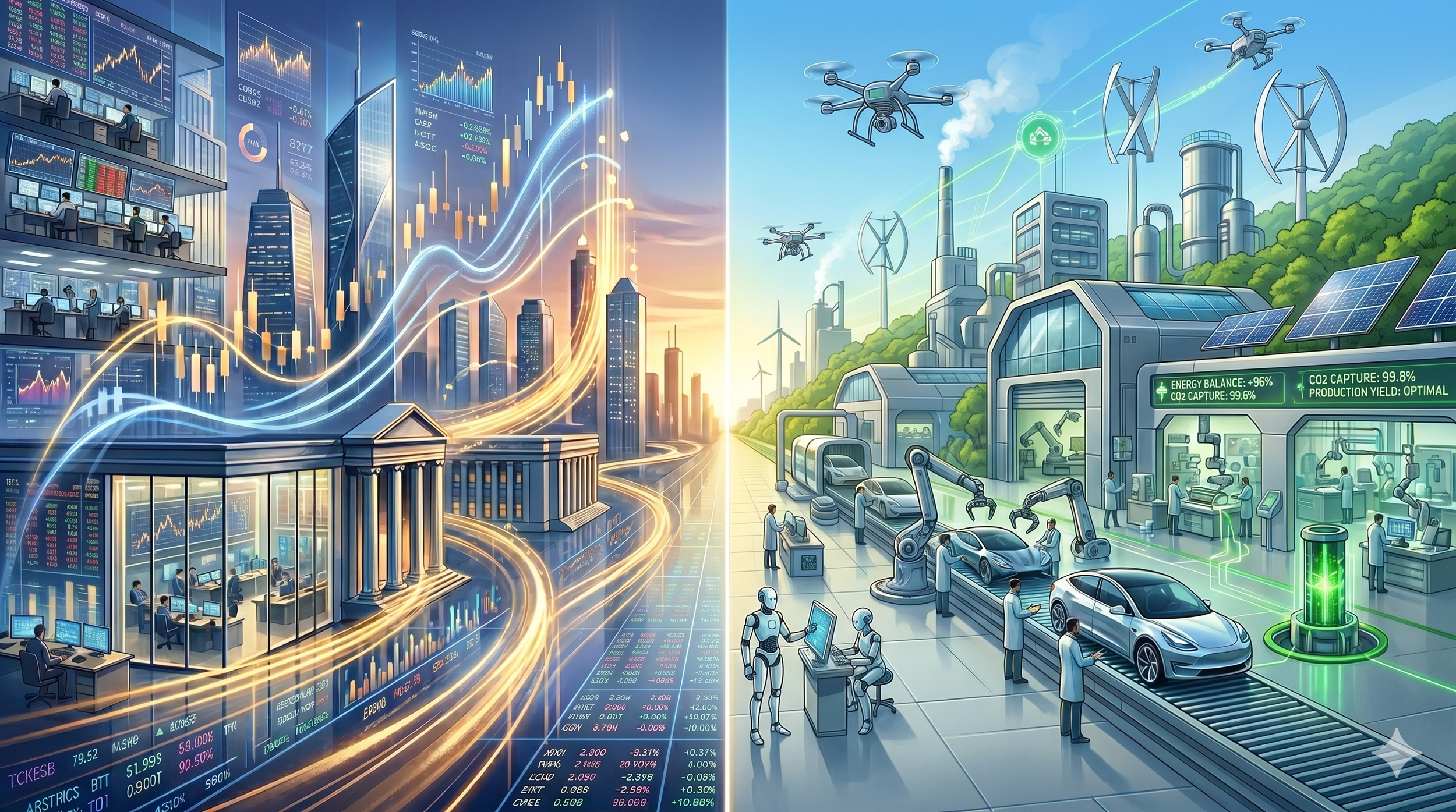
One runs unsustainable profit-maxxing — chasing benchmarks and cool demos to spin sweet narratives for investors, while saddling its own industry with high prices to justify the stock price of a few.
The other runs sustainable token-maxxing — using low prices to move the whole economy up a level.
Greed is good — up to a point. Past that point, it corrodes everything. The global economic race won’t be won by whoever builds the best model. It’ll be won by the system that can afford to let everyone use it.
Because we don’t use AI just for AI’s sake!
Outside the innovation-theater world, it will drive much deeper changes. And the company rationing AI to a few approved use cases will eventually compete, for the same customers, against rivals who built their whole operation on AI because it was cheap. That’s the real danger — something I wrote about a couple of weeks ago, after the Citrini scare.
So in the end the question is which economy, not which company, will win the race we’re all in after those IPOs.