Experience, Community & AI: China’s Ecosystem Playbook for Brands & Retailers.
EV showrooms are out. Pop Mart, Lululemon, and robot dogs are in. Three ideas from China’s malls — and one strategy that ties them together.
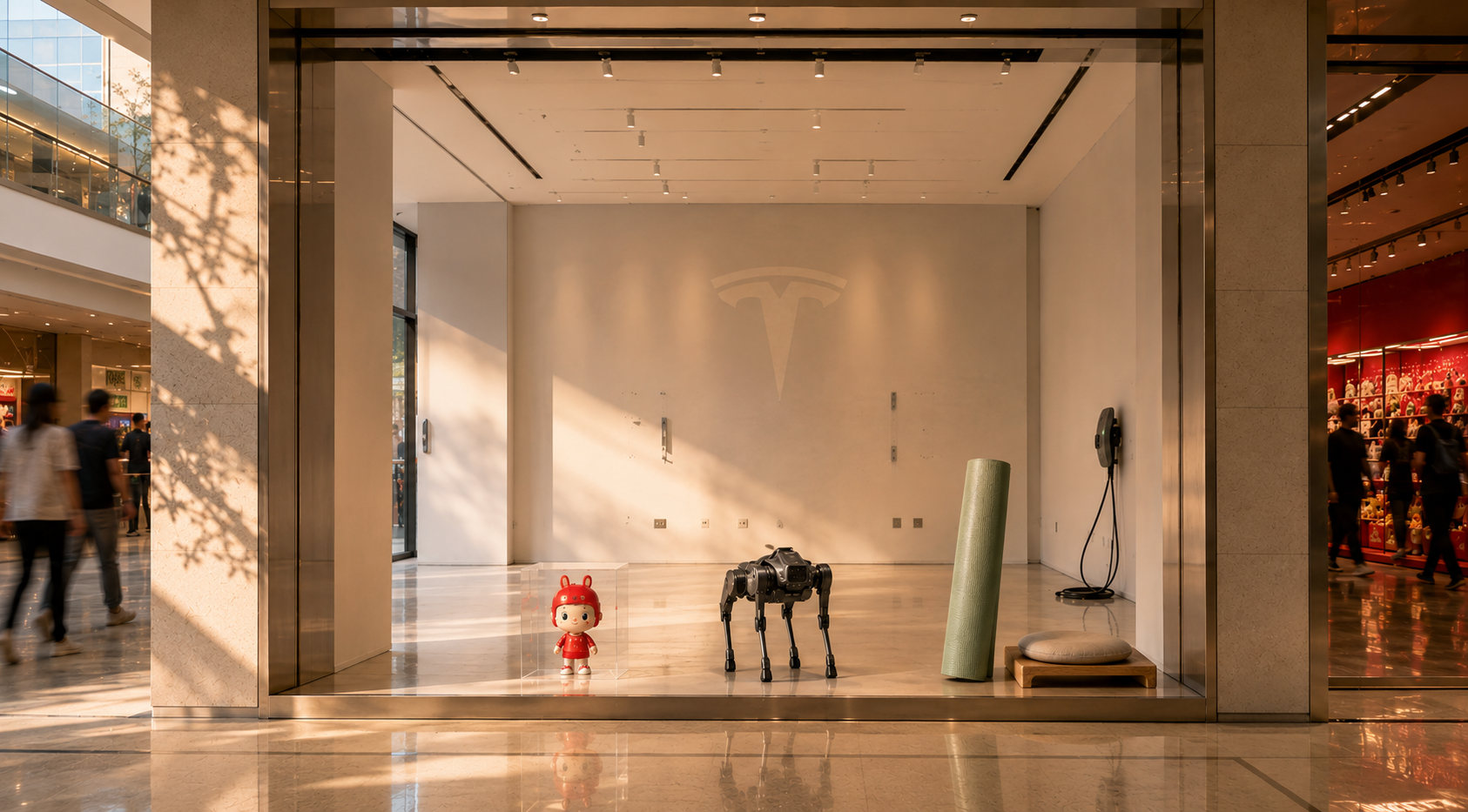
Three years ago, the ground-floor in premium Chinese malls was wallpapered with EV showrooms — Tesla, Nio, Xpeng, Li Auto. Today in those exact same spaces you find little monsters, yoga sessions, or high-fives with robot dogs.
This may not just be an isolated trend in China, but rather a harbinger of things to come here, too.
Ashley Dudarenok has an interesting piece on Jing Daily about the shift: Pop Mart flagships posting 185% revenue growth to $5.4B on the back of a designer toy. Lululemon community studios with China revenue up 29%. Unitree’s experiential robot store in Beijing pulling crowds that EV showrooms used to. All a sign that Chinese consumers have reallocated their budgets from big-ticket status symbols toward identity, wellness, and immersive experience. Services consumption is now outpacing goods retail nearly 2:1.
Okay, but how is this relevant to retail in the West?
Ashley’s text offers three ideas, and one strategy that ties them together, which we might use for our own markets here.
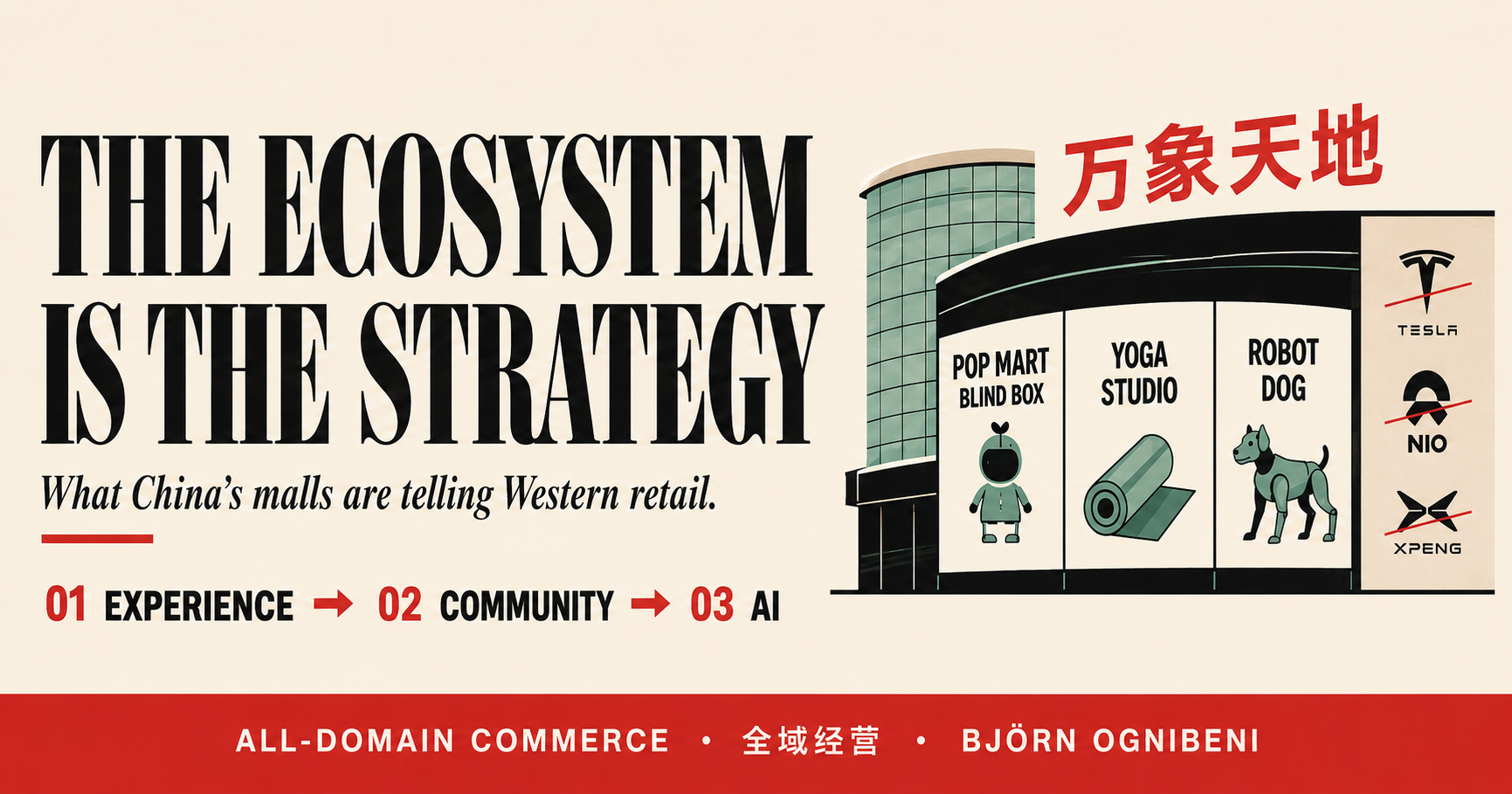
Physical retail has a future when it offers what online can’t: Experience!
Online has won on speed, price, assortment, and convenience. What online struggles to do is create embodied, shared, tactile experiences. Pop Mart isn’t winning on toys — it sells an emotional rush, a tribe, an identity. Lululemon isn’t winning on leggings — the store is a yoga studio with a checkout. The Unitree store isn’t just selling robots — it provides shareable moments. Great ways to justify a physical space.
That retail should try “experience” to revive itself is hardly new. Many such concepts have failed in the West. But maybe they failed because they were whiteboard fantasies — experience as a marketing campaign, not as part of a bigger ecosystem.
Reimagining the physical store: as a community space.
What is often missing in Western business is a real social component: seeing brands and stores as entities that bring people together. The standard pushback is that “social” is a Chinese cultural quirk. And it is — but we’re in a moment of political uncertainty, economic anxiety, and a loneliness epidemic on both sides of the Atlantic. The potential for real, in-person, low-stakes social experience isn’t smaller in the West. It’s probably larger — because there is so little of it left.
And Agentic AI is poised to become an accelerant here. As every customer touchpoint gets hyper-efficient, hyper-personalized — and ultimately hyper-sterile — the few remaining human, tactile, communal moments only become more valuable. The more frictionless and machine-mediated commerce becomes, the higher the premium on everything that isn’t.
The next phase of Western retail may belong to brands that do not see AI and physical retail as opposites — but as complements. Starting to think of stores and brands as social hubs where people simply want to be. With other people.
All-Domain Commerce: Thinking beyond Omnichannel.
Chinese retail increasingly optimizes for ongoing relationships, not isolated transactions. But in the West, “experience” and “community” often fail to scale because we still run them as separate channels: e-commerce here, retail there, social in marketing, CRM somewhere else.
Omnichannel often means these pieces are technically connected, but not operated as one relationship system. And the most important touchpoints are often the ones least directly tied to transactions: social content, communities, fan conversations, creator posts, service moments.
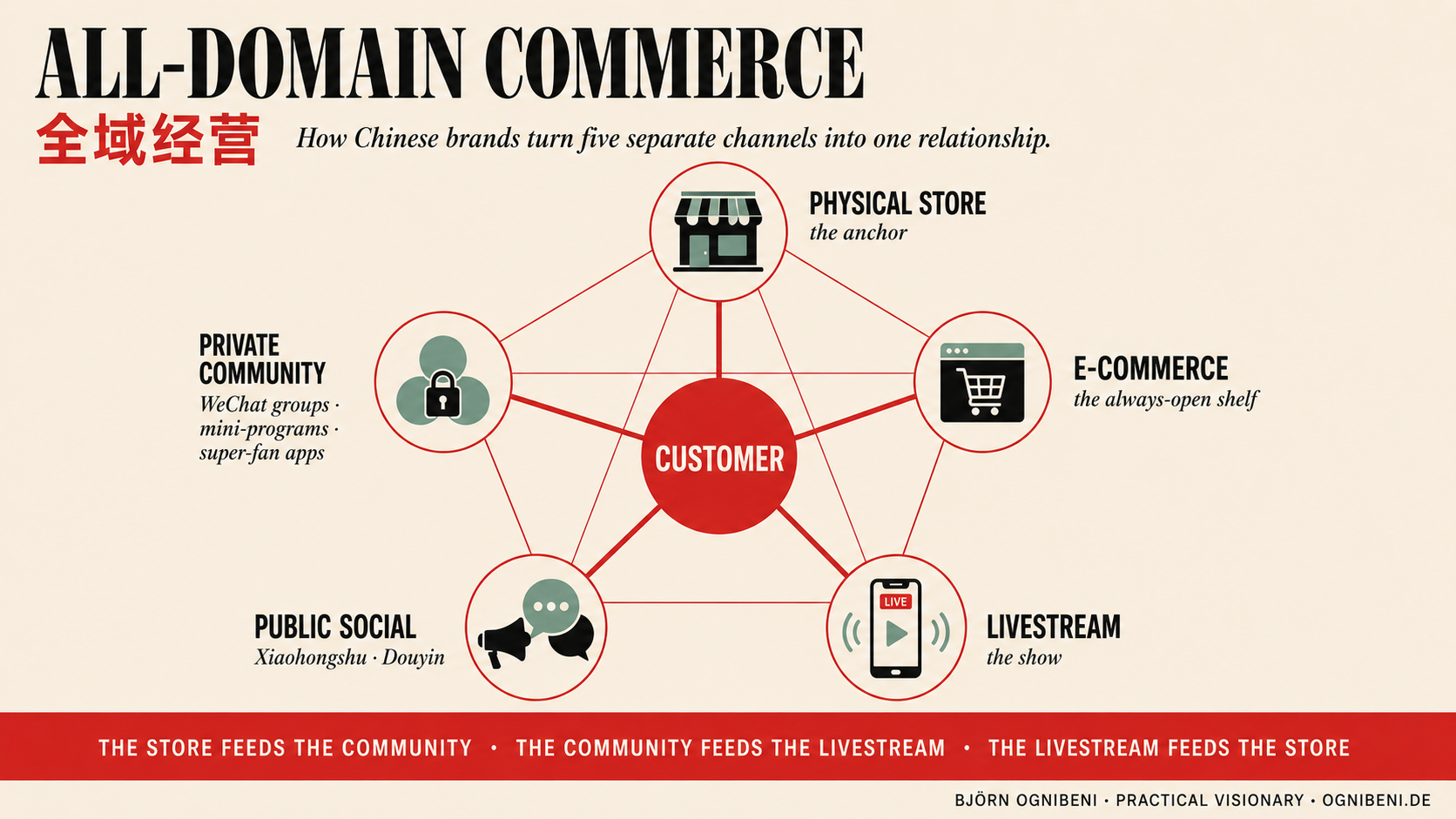
Treating them separately destroys the synergies that could make experience and community scale. This is where China’s idea of all-domain commerce (全域经营) becomes interesting: leading Chinese brands think in domains — physical stores, e-commerce, livestreaming, public social platforms like Xiaohongshu and Douyin, and private communities such as WeChat groups, mini-programs and super-fan apps.
The customer flows through all of them in a single relationship. The store feeds the community, the community feeds the livestream, the livestream feeds the store.
And brands that merge all of that into one ecosystem — public reach, private depth, online convenience, offline emotion — have a structural advantage over those still optimizing channels in isolation.
AI as a Community Engine
And AI is what makes this kind of ecosystem operational at scale — orchestrating content, personalization and engagement across domains in ways that simply weren’t possible a few years ago. But the interesting part is that AI does not have to replace human content or human interaction. It can also make existing human signals more visible and more useful.
A platform like Xiaohongshu shows the logic: search does not just return brand-owned content or AI-generated summaries. It can connect thousands of posts, reviews, tips and experiences from real users around a brand, product or lifestyle. In that sense, AI-powered discovery can create something close to an instant brand community — bringing together brand content, user content and fan conversations in one shared context.
AI shouldn't replace community. AI should enable community.
The real lesson: The ecosystem is the strategy.
The lesson is not that Western retailers should copy Chinese mall concepts. It is that we might need to rethink retail and branding as ecosystems across every domain the customer lives in. Experience brings people into the store. Community brings them back. And AI makes the whole thing run.
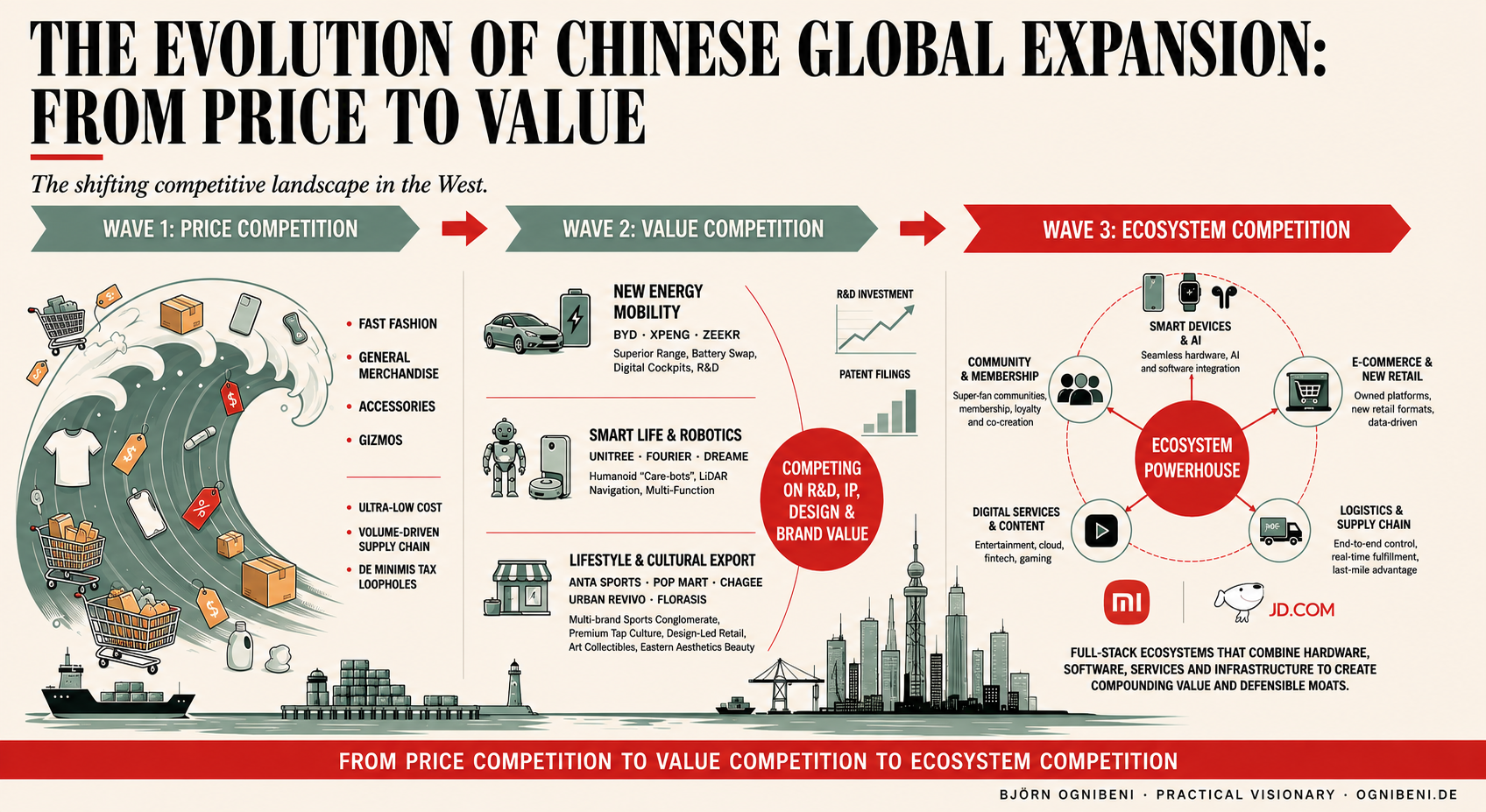
The question isn’t whether this is coming west. It’s whether we try building it now, or keep debating it until oother show us how it works. Because the next generation of Chinese competitors won’t win because they’re cheap or have better products; they’ll win because they’re able to provide a more convenient ecosystem experience…
If this resonates, I’ll be talking about these themes at two upcoming events:
🎤 Digital Experience Days 2026 — Berlin, June 22nd: on Brand Ecosystems
🎤 Retail Innovation Days 2026— Heilbronn, July 9th: on All-Domain Commerce
If you’re attending either, come say hi.