Why the Iran War Cements China’s AI Advantage: Scaling Requires Predictability.
Agentic AI is fundamentally changing the cost structure of the industry. The Iran war turns that into a problem. And China into the winner.
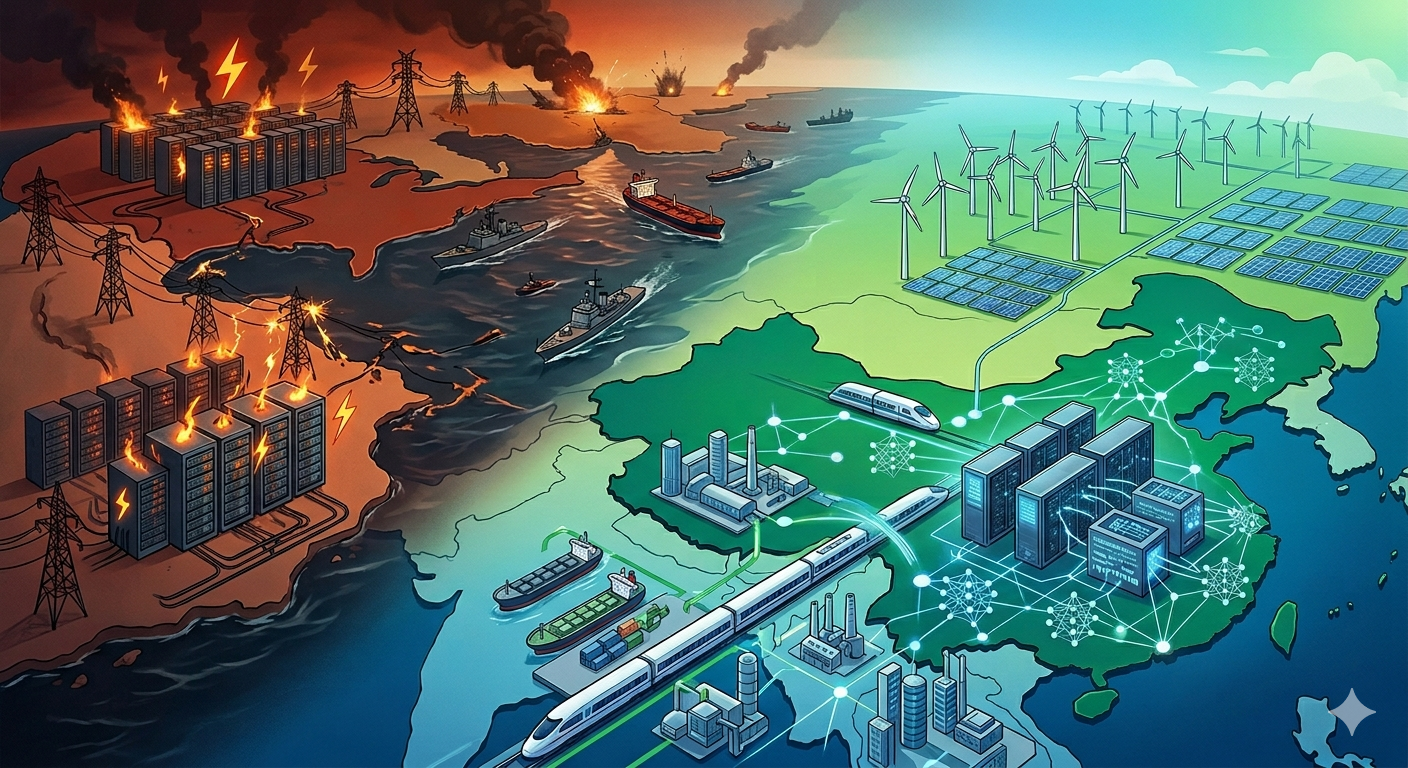
In the current race for long-term AI domination, one country is clearly ahead. No, not the US — China!
Because China isn’t chasing the fastest benchmarks for short-term bragging rights. Instead, it’s deliberately laying the foundation for companies to build tomorrow’s competitive advantages today. In the West, this kind of foundation is sorely missing — and the Iran war isn't making things any better.
To understand why, look at the hottest topic in AI development right now: Agentic AI.
Anyone experimenting with tools like OpenClaw or Claude Cowork notices immediately: these systems consume multiples of the tokens a conventional chatbot requires. Where a simple prompt generates a brief response, an autonomous AI agent burns through thousands of tokens for a single task. It plans, executes, self-corrects, replans. This isn’t a marginal increase in compute demand. It’s a structural break. And tokens, at their core, mean one thing: compute — and therefore energy.
This is exactly where the next phase of the AI revolution collides with a geopolitical reality whose full scale the industry doesn’t seem to have grasped yet.
The Iran War as Accelerant
The conflict around Iran and the Strait of Hormuz has thrown global energy markets into turmoil. The strait is effectively closed to most commercial shipping — oil and natural gas exports are affected, but so are critical inputs for chip manufacturing like helium. If its effects persist, the Iran war threatens AI data centers on two fronts simultaneously: new construction through constraints on chip production, and operations through rising energy costs.
For AI prototypes in a lab, this is irrelevant. For the industrial scaling of agentic AI, it changes everything.
The Fragile Foundation of the Western AI Industry
The problem runs deeper than rising electricity prices. As The Atlantic laid out in a detailed analysis recently, the entire AI industry is a fragile system of interlocking dependencies. The hyperscalers — Google, Microsoft, Meta, Amazon — are currently spending hundreds of billions of dollars per year on infrastructure. They’ve taken on historic levels of debt to do so. Private equity firms like Blackstone and Blue Owl, which now effectively operate as shadow banks, finance data center construction with money from pension funds and endowments.
The underlying business model is actually deflationary: in theory, AI tokens are a kind of industrial intermediate product, but unlike traditional commodities, the price per token keeps falling through technological progress. The data centers producing these tokens also lose value as their chips get leapfrogged by the next generation. AI assets depreciate far faster than conventional investments. Meanwhile, hyperscaler debt is rising rapidly.
And now this situation is being exacerbated by the war in Iran: chips become more expensive to manufacture, data centers more expensive to operate. Even though the tech giants are among the most profitable companies in history, the sums involved here can push even them off balance — especially if investors and markets lose faith in their AI dreams. That can quickly ripple through to institutional investors, and from there to the pension funds and insurers managing normal people’s money. It only takes a few of these dominoes falling.
But even setting all that aside, there’s a fundamental infrastructure problem as well: the US simply lacks the electricity to power all the data centers it has planned. The grids are outdated, with virtually no headroom to significantly increase energy consumption in the short term. You can build a data center in months; expanding power infrastructure takes years. Off-grid solutions like gas-fired power plants built alongside data centers are an option. But the necessary turbines are sold out for years, and the associated energy costs are likely to be substantial — driving up the resulting cost of compute accordingly.
And the token prices that Western companies are currently building their AI strategies on? They’re still subsidized by speculative capital. When markets lose confidence or the grid hits its limits, those prices will spike.
Smart Move for Western Industries: Don't scale AI
These dynamics should be pretty obvious to any rationally acting company. And given the steadily rising cloud costs of recent years, nobody should be under any illusions about where AI costs are headed.
On top of that: once a company has replaced much of its workforce with AI agents, it becomes completely dependent on that AI service provider — because the tacit knowledge those employees once held is gone. If the AI company then decides to squeeze its clients, there wouldn’t be much they could do about it. Switching AI providers tomorrow will likely be far harder than switching ERP systems is today.
All of this is likely to ensure that companies in the West only very hesitantly restructure their business models around AI in the way that would be necessary to achieve truly macroeconomic effects beyond simple efficiency gains. To do so, companies need predictability of future AI costs and trust in the providers delivering them.
In China, that’s exactly what government and business are working toward — with China Speed.
China’s Different Path
While the US neglected its energy infrastructure, China has spent the last two decades building a robust energy infrastructure with significant overcapacity. When a new AI data center comes online there, the power is already available — and it’s cheap. Not least because of the consistent expansion of renewable energy.
But China’s advantage doesn’t stem from power generation alone. It also comes from a fundamentally different AI development philosophy. While US companies optimize for benchmark records in order to impress markets and investors — the most powerful model, whatever the cost — Chinese AI firms focus on energy efficiency. DeepSeek, MiniMax, and other proponents of the “Frugal AI” movement use architectures that achieve more with less compute. The result isn’t a marginal cost advantage. Chinese companies can scale agentic AI at a fraction of what their American competitors have to pay.
Accordingly, China’s new Five-Year Plan — with its AI+ initiative — already treats artificial intelligence as industrial base infrastructure, comparable to electricity or the internet. AI is meant to be deployed everywhere — in research, manufacturing, logistics, and administration. Not as a pilot project, but as a factor of production. This strategy only works, however, if input costs are stable and predictable. And that’s exactly what an energy system delivers when it’s been built by a state that thinks in decades rather than quarterly earnings. Companies can rely on that and get to work realizing the competitive advantages it enables.
The risk for their US competitors is obvious: if AI remains too expensive for scaled, industrial deployment, it becomes “Luxury Boutique AI” — impressive in demos, irrelevant in practice.
And when more companies worldwide should turn to Chinese AI models — not because they’re the most powerful, but because they’re good enough and come with predictable costs — China would be able to repeat the playbook it has run in sector after sector: offer solid quality at unbeatable prices, scale relentlessly, and monopolize the market before competitors realize what happened. EVs, consumer electronics, solar panels — and now tokens. In effect, China would be exporting cheap green energy in tokenized form, one API call at a time.
The bottom line: China isn’t winning the benchmark competition, but it’s winning the scaling competition — which is much more important.
What Does This Mean for Europe?
Europe faces uncomfortable decisions. The reflexive European policy response — throwing money at copying the Silicon Valley model — could turn out to be an extremely expensive mistake. Because if the basic assumptions of that US model are really not valid, Europe isn’t copying innovation. It’s copying risk.
And Europe’s energy situation is no less precarious. Quite the opposite. The continent is hit even harder by fossil energy price swings from the Iran conflict than the US. Building an AI strategy based on energy-hungry frontier models under these conditions isn’t ambitious — it’s reckless.
At the same time, Europe lacks the alternative that China has: there are no comparable overcapacities in cheap renewable energy yet, no overarching coordinated AI+ strategy, no Frugal AI ecosystems. Europe is caught between a rock and a hard place: too dependent on American AI infrastructure that’s threatening to collapse under its own contradictions, and too slow to catch up with China’s efficiency advantage.
If Silicon Valley no longer works as a role model and we don’t want to make ourselves dependent on China, the question becomes: what would a third way look like?
It should pursue two goals in parallel:
leverage Europe’s solid research capabilites to develop new forms of AI as alternatives to the US fixation on LLMs, as people like Yann LeCun are already attempting.
Simultaneously, on the basis of adapted, energy-efficient open-source models, do everything possible to drive AI adoption — analogous to AI+ in China.
But not with the goal of making as many people unemployed as quickly as possible to drive up market caps, but with alternative approaches like Audrey Tang’s vision of “Augmented Collective Intelligence” — systems that make people collectively smarter, rather than individually redundant.
Because one thing is becoming increasingly clear: the winners of the global AI competition won’t be those who build the most powerful models. They’ll be those who can afford to run them — at scale, economically, sustainably, and without tearing apart the social fabric in the process.
Right now, China looks significantly better positioned than the West. And Europe hasn’t even begun to seriously engage with any of this.
It’s high time.