China Isn't Racing to AGI. Why Are We?
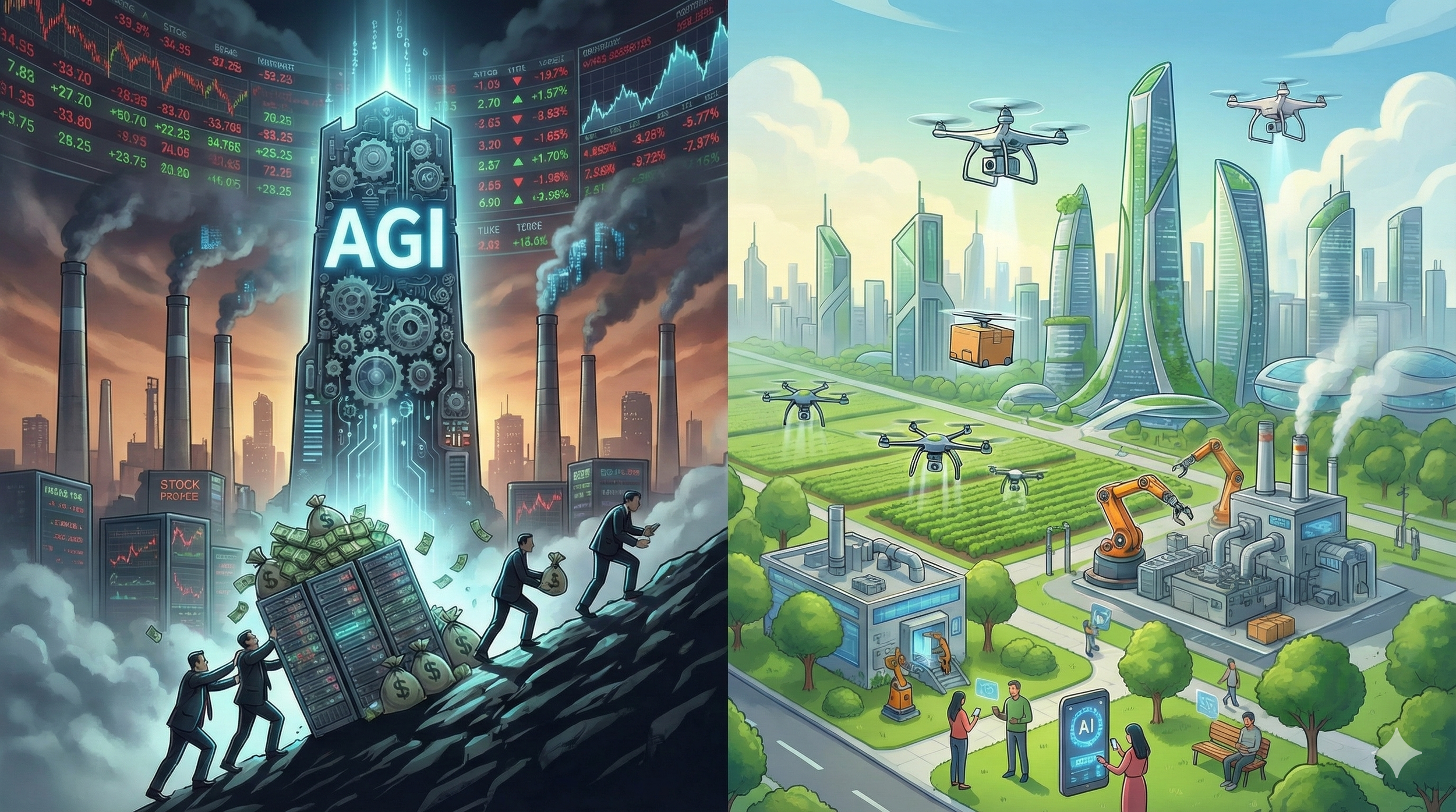
Made with Gemini
I just finished a fascinating episode of "Your Undivided Attention" with Tristan Harris, featuring China experts Selina Xu and Matt Sheehan. The conversation highlights a striking parallel to the 1950s "missile gap"—a false narrative that ignited a nuclear arms race during the Cold War.
Today, we risk a similar mistake by misperceiving China as a monolithic entity single-mindedly racing toward AGI—leaving us feeling we have no choice but to follow the same futile path. In reality, China’s ecosystem is much more diverse and focused on a pragmatic strategy that we in the West often fail to understand. Once again, we risk opening a Pandora’s box, not because of a real threat, but because of our own misconceptions.
But the whole current AGI craze in the West points to a bigger problem beyond AI, exposing a fundamental flaw in Western late-stage capitalism. In the West, we’ve seemingly forgotten that a healthy market economy requires real competition to drive innovation. Instead, our tech giants have built a world of monopolies and "insane" profits.
The result? Innovation has become secondary to the Narrative.
📈 US Focus: Narrative & Market Cap
In the US, the KPI that matters most is Market Cap. This "race for AGI" and the staggering investments accompanying it often feel like a narrative designed to keep investors hooked. If a technology doesn’t feed the stock price, it’s a distraction. So, we are pumping vital resources not into making better products or services, but into inflating bubbles.
🇨🇳 The Chinese Counter-Perspective: "AI Plus"
The podcast highlights a starkly different reality in China. While we obsess over creating a superintelligence, China is executing a strategy called "AI Plus." Their focus is not, as Selina Xu puts it, on an “anthropomorphic machine god.” In China, it is all about integrating AI into manufacturing, healthcare, and governance to drive actual value—using it to leapfrog the middle-income trap and manage a rapidly aging population through robotics and automation.
⚠️ The Risk of the Bubble: A Misallocation of Human Progress
When we step back from the hype, it becomes clear that China’s approach—focusing on applying AI to solve real problems rather than just scaling benchmarks—is simply more sustainable. It is grounded in sound business thinking and is therefore more likely to yield long-term economic stability.
In contrast, by chasing a speculative "God in a box," the West is wasting the resources of society at large - pouring brilliant minds and trillions of dollars into a narrative bubble rather than improving the quality of lives.
Will this change if the bet is won and AGI is achieved? Probably not. The "winner" will then have to scale this artificial god to drive growth and justify astronomical valuations. In a world already dominated by a trend of "enshittification," it is very difficult to see a scenario where the society that provided those massive resources will actually profit as a whole.
This will only solidify the drive toward monopolization and the lack of real competition that is at the root of this all. Instead we should remember that the goal of a market economy is not to guarantee giant profits for giant corporations, but to allocate scarce resources in the most efficient way for us all. In a healthy system, competition makes it difficult to maintain massive profit margins—but that is not a bug, it is the primary feature.
When we prioritize market cap over tangible value, we don’t just risk a bubble; we fail to use AI for what it should be: an engine for shared prosperity.
Made with Gemini